Serbia without Vučić: Europe celebrates — but did anyone read the winners' programme?
Serbia has voted for political change. Europe sees an opportunity for a new beginning. But the victorious Student List's foreign-policy programme raises an uncomfortable question: has Belgrade changed its geopolitical direction, or merely the people who will govern it?
A POLITICAL EARTHQUAKE — BUT NOT NECESSARILY A GEOPOLITICAL ONE
On 25 October 2026, Serbia delivered a decisive electoral defeat to the political establishment associated with Aleksandar Vučić.
According to preliminary results announced by Serbia's Republic Electoral Commission on 26 October, the Student List secured 52.71% of the vote and a projected 140 seats in the 250-member National Assembly. Vučić's electoral alliance received 39.17%.
For a country whose political system has been dominated by Vučić and his allies for more than a decade, the result represents a profound domestic transformation.
The student movement emerged from protests demanding accountability, functioning institutions and an end to entrenched corruption. Its electoral success is a remarkable demonstration of political mobilisation.
But the celebrations risk obscuring a question of enormous importance to Europe's security.
What, precisely, has Serbia voted to change?
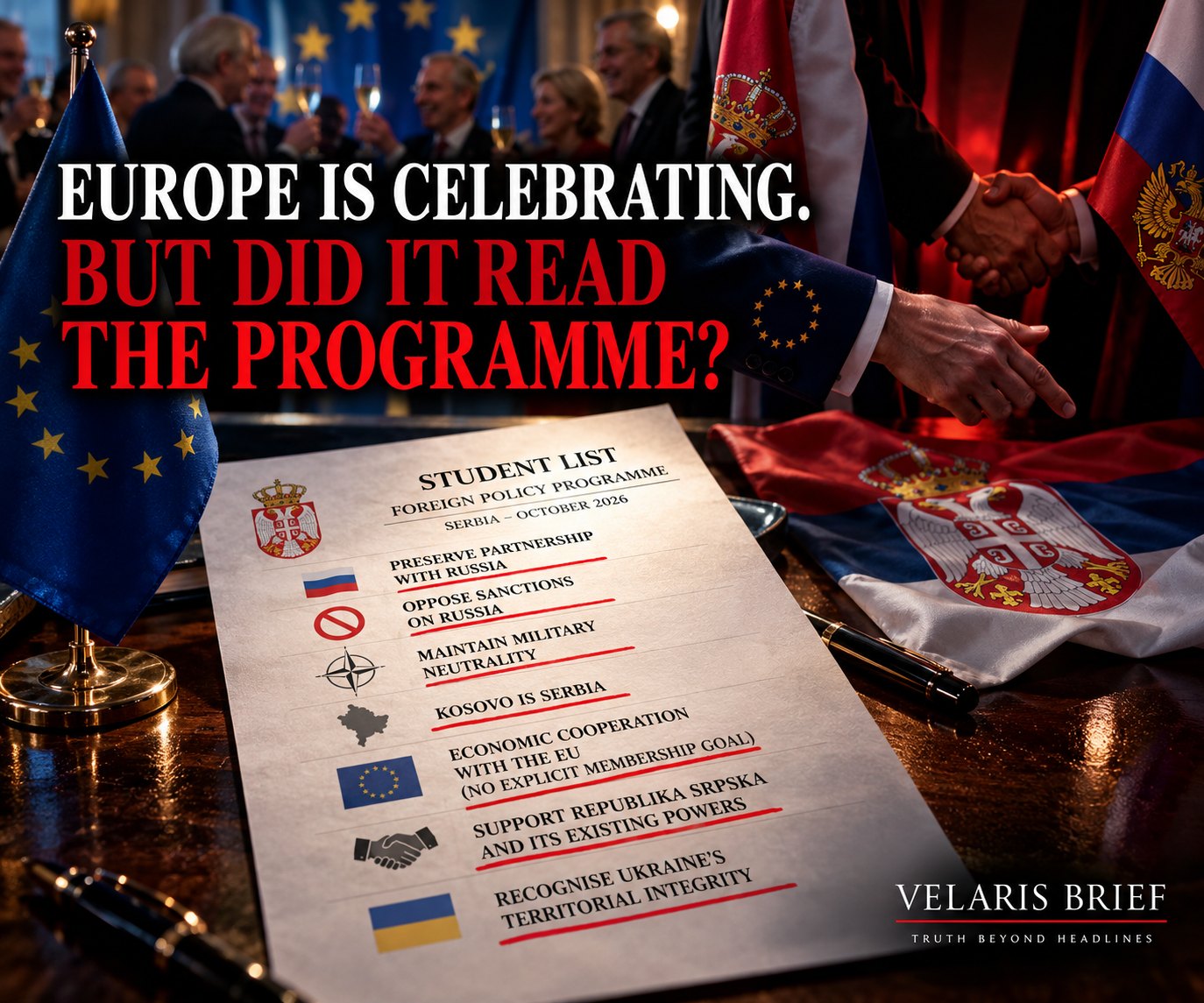
The answer becomes considerably more complicated when we examine the winning movement's published foreign-policy programme.
Its positions on Russia, European integration, Kosovo, NATO and Bosnia and Herzegovina reveal substantial continuity with long-established Serbian policies.
That does not invalidate the democratic significance of the election.
It does, however, challenge the assumption that Vučić's defeat automatically represents a strategic defeat for Vladimir Putin.
Europe should distinguish between the two.
RUSSIA: THE PARTNERSHIP SURVIVES
One of the clearest positions in the Student List's programme concerns the Russian Federation.
The movement proposes preserving Serbia's traditional partnership with Moscow, particularly through diplomatic coordination in the United Nations Security Council and cooperation on issues related to Serbia's territorial claims.
More significantly, it explicitly opposes imposing sanctions on Russia.
This is not an incidental policy detail.
Since Russia launched its full-scale invasion of Ukraine in February 2022, Serbia's refusal to align with European sanctions has remained one of the most visible contradictions in its relationship with the European Union.
The Student List's programme does not resolve that contradiction.
It preserves it.
For years, European policymakers have struggled with Serbia's attempt to maintain extensive economic relations with the EU while retaining important diplomatic and energy relationships with Russia.
The new political programme suggests that this balancing strategy may continue.
If the winners intend to preserve cooperation with Moscow and reject sanctions, on what grounds should their victory be interpreted as the end of Russian influence in Serbia?
A change of leadership may alter the character of bilateral relations. Moscow could lose privileged access to particular officials, institutions or commercial arrangements.
But losing a preferred political partner is not the same as losing strategic influence.
Russia's interests in the Balkans do not depend exclusively on one Serbian politician.
They also depend on political positions, unresolved territorial disputes, diplomatic relationships and economic connections that can survive changes of government.
The Student List's programme offers little evidence that those foundations are about to disappear.
EUROPEAN UNION: ECONOMIC PARTNERSHIP WITHOUT AN EXPLICIT MEMBERSHIP COMMITMENT
The Student List identifies the European Union as Serbia's most important economic partner.
It advocates expanding strategic cooperation with EU member states and pursuing progress in areas associated with accession negotiations, particularly judicial reform and fundamental rights.
It also seeks closer cooperation with European financial institutions, including access to grants and development financing.
These are meaningful commitments.
But there is an important omission.
The programme does not explicitly establish full EU membership as Serbia's ultimate strategic objective.
That distinction deserves far more attention than it has received.
Economic integration and political integration are not interchangeable.
A country can seek European investment, infrastructure funding, trade access and institutional cooperation without committing itself to the full political obligations of EU membership.
The European Union has every reason to encourage democratic reforms in Serbia.
But it should also ask whether the country's prospective leadership is prepared to make the difficult foreign-policy decisions that genuine European integration requires.
Can Serbia maintain its opposition to sanctions against Russia indefinitely while moving toward EU membership?
Can accession negotiations advance without meaningful progress in normalising relations with Kosovo?
And can Brussels continue treating economic cooperation as evidence of political convergence when the winning programme itself leaves the ultimate destination undefined?
Europe should welcome reform. It should not mistake access to European money for a commitment to European political alignment.
NATO: THE POLICY OF MILITARY NEUTRALITY CONTINUES
The Student List also confirms Serbia's longstanding policy of military neutrality.
This position predates Vučić's rise to power.
Military neutrality is a legitimate sovereign choice, and Serbia is under no obligation to seek NATO membership.
But that is precisely the point.
There is no basis for presenting the Student List's victory as a decisive strategic movement toward the Atlantic alliance.
The programme offers continuity rather than transformation.
Combined with its opposition to Russian sanctions and commitment to maintaining cooperation with Moscow, military neutrality suggests that Serbia's future government intends to preserve considerable freedom to balance competing international relationships.
That may be a rational choice from Belgrade's perspective.
But Europe should evaluate it for what it is.
Serbia's democratic transformation does not automatically make it a Western security partner.
KOSOVO: THE FUNDAMENTAL DISPUTE REMAINS
The programme's position on Kosovo is equally revealing.
The Student List continues to regard Kosovo as an integral part of Serbia.
It rejects Kosovo's declaration of independence and opposes its membership in international organisations.
It also proposes reviewing agreements concluded by previous Serbian governments and examining whether officials acted contrary to Serbia's Constitution.
The programme calls for extensive autonomy for Serb-majority municipalities and the preservation of Serbian cultural, educational and religious institutions.
Some of these objectives concern legitimate minority protections.
Others directly challenge Kosovo's internationally contested status and raise questions about the future of agreements negotiated under European mediation.
For Brussels, this presents an immediate dilemma.
The EU has spent years attempting to normalise relations between Belgrade and Pristina.
A new Serbian government that retains the same fundamental position on Kosovo — while potentially reopening previous agreements — does not automatically make that process easier.
Changing the negotiators does not necessarily change the objectives of the negotiations.
The relevant test will not be whether Serbia's new leaders speak more politely to European officials.
It will be whether they implement existing commitments, reduce tensions and accept arrangements that make peaceful coexistence possible.
Until then, the Kosovo question remains unresolved.
And unresolved territorial disputes remain vulnerable to political exploitation.
BOSNIA AND HERZEGOVINA: REPUBLIKA SRPSKA REMAINS A PRIORITY
Perhaps the most sensitive regional implications concern Bosnia and Herzegovina.
The Student List's programme supports preserving the constitutional position and established powers of Republika Srpska.
It specifically refers to the entity's veto mechanisms within Bosnia and Herzegovina's common institutions and to disputes concerning movable and immovable property.
The programme also challenges aspects of the international High Representative's authority, including the use of the so-called Bonn powers.
It proposes strengthening Serbia's special relations with Republika Srpska across economic, infrastructure, educational, cultural and security-related fields.
These positions do not amount to an explicit declaration of support for Republika Srpska's independence.
That distinction matters.
Nevertheless, they show that the future Serbian leadership intends to remain actively involved in constitutional disputes that have repeatedly destabilised Bosnia and Herzegovina.
The question is not whether Serbia may maintain legitimate relations with Republika Srpska.
Under the Dayton framework, special parallel relations are permitted within defined constitutional limits.
The question is whether Belgrade's involvement will strengthen Bosnia and Herzegovina as a sovereign state or encourage political actors to resist its common institutions.
Europe should be particularly cautious here.
Bosnia and Herzegovina's constitutional structure emerged from the peace agreement that ended a devastating war.
The genocide at Srebrenica and the broader record of atrocities committed during that war are established historical and judicial realities.
They cannot be erased from discussions about the region's political future.
At the same time, those crimes do not establish collective guilt for today's inhabitants of Republika Srpska.
The essential principle is that Bosnia and Herzegovina's sovereignty, territorial integrity and functioning institutions must not become bargaining chips in Serbia's relations with larger powers.
A democratic transition in Belgrade will be judged partly by whether it contributes to that stability.
CROATIA: RECONCILIATION REQUIRES MORE THAN A CHANGE OF GOVERNMENT
The Student List's programme also addresses the position of ethnic Serbs in Croatia.
It emphasises minority rights, cultural and linguistic identity, returnees, judicial proceedings and the implementation of relevant bilateral agreements.
The protection of minority rights is a legitimate responsibility of democratic states.
But relations between Croatia and Serbia cannot be reduced to minority policy alone.
They remain affected by unresolved questions arising from the wars of the 1990s: missing persons, accountability for crimes, historical revisionism and competing political narratives.
For Croatia, the central question is whether a new government in Belgrade will approach these issues differently from its predecessors.
Will it cooperate more effectively in locating missing persons?
Will it confront documented crimes without political relativisation?
Will it distinguish legitimate concerns about minority rights from attempts to rewrite the history of aggression and occupation?
These are practical questions, not demands for collective guilt.
A new Serbian government deserves an opportunity to demonstrate a different approach. But that difference must be visible in its actions.
The election result alone cannot provide the answer.
UKRAINE: TERRITORIAL INTEGRITY IN WORDS, NO SANCTIONS IN POLICY
The Student List's programme recognises Ukraine's sovereignty and territorial integrity.
That commitment should be recorded accurately.
But it exists alongside a decision to oppose sanctions against Russia.
This creates an obvious political tension.
Russia's full-scale invasion of Ukraine represents a direct assault on the territorial integrity the programme says it supports.
Yet the proposed Serbian response excludes one of the principal instruments used by the European Union to impose economic and political costs on Moscow.
Serbia is entitled to determine its foreign policy.
Europe is equally entitled to ask what that policy means in practice.
What does support for Ukraine's territorial integrity amount to if Serbia simultaneously preserves its traditional diplomatic partnership with the state violating it?
There may be diplomatic arguments for maintaining communication with Moscow.
There may also be economic costs associated with sanctions.
But those considerations should be debated openly rather than concealed beneath reassuring declarations of principle.
The distinction between words and policy matters.
Especially during a war.
IS EUROPE CELEBRATING TOO EARLY?
The defeat of an entrenched political establishment can be a major democratic achievement.
Serbia's student movement has mobilised citizens against corruption, institutional weakness and the concentration of political power.
Those achievements should not be dismissed.
But neither should they be confused with a completed geopolitical transformation.
The published programme contains several positions that resemble the strategic priorities of previous Serbian governments.
Partnership with Russia remains.
Opposition to Russian sanctions remains.
Military neutrality remains.
The refusal to recognise Kosovo remains.
Republika Srpska's constitutional position remains an important Serbian foreign-policy concern.
And the programme does not explicitly identify full EU membership as Serbia's ultimate strategic destination.
These are not minor technicalities.
They are central questions of European security and regional stability.
The possibility that the new government will pursue genuine democratic reforms does not make those questions disappear.
Nor does the programme prove that Russia engineered the political transition, that the student movement serves Moscow or that its leaders will inevitably reproduce Vučić's policies.
Such claims would require separate evidence.
But the absence of evidence for a secret Russian operation does not erase the evidence of declared political continuity.
That distinction is essential.
Europe does not need to discover a conspiracy to recognise a strategic problem.
It needs only to read the programme.
THE REAL TEST BEGINS AFTER THE CELEBRATIONS
Serbia's future direction will ultimately be determined by decisions rather than declarations.
Will the new government strengthen independent institutions?
Will it confront corruption regardless of political affiliation?
Will it align more closely with European foreign policy?
Will it maintain its refusal to sanction Russia?
Will it implement agreements concerning Kosovo?
Will it respect Bosnia and Herzegovina's sovereignty while maintaining relations with Republika Srpska?
Will it improve relations with Croatia through meaningful cooperation on unresolved wartime issues?
Those decisions will reveal whether Serbia is undergoing a transformation of its political system alone or a broader change in its relationship with Europe.
For now, the available evidence supports a more restrained conclusion than the triumphalist narrative surrounding Vučić's defeat.
Serbia has voted to remove an established political order.
It has not, through the Student List's published programme, clearly committed itself to abandoning the geopolitical positions that defined much of that order.
Europe should celebrate democratic participation.
It should support institutional reform.
It should encourage accountability and regional reconciliation.
But it should resist the temptation to declare a geopolitical victory before the new leadership has demonstrated one.
The Balkans have already paid a devastating price for political miscalculations, selective attention and misplaced confidence.
They deserve better than another round of optimistic assumptions.
Before Europe celebrates Serbia's new direction, it should establish whether that direction is actually new.
And the first place to look is not a television studio, a diplomatic reception or a politician's congratulatory message.
It is the winners' own programme.
Research basis: the Student List's foreign-policy and national-security programme, as analysed by Professor Dejan Jović for the Foreign Policy Forum (Zagreb); preliminary election results published by Serbia's Republic Electoral Commission on 26 October 2026. The geopolitical assessments and conclusions are editorial analysis.
Source: Velaris Brief